
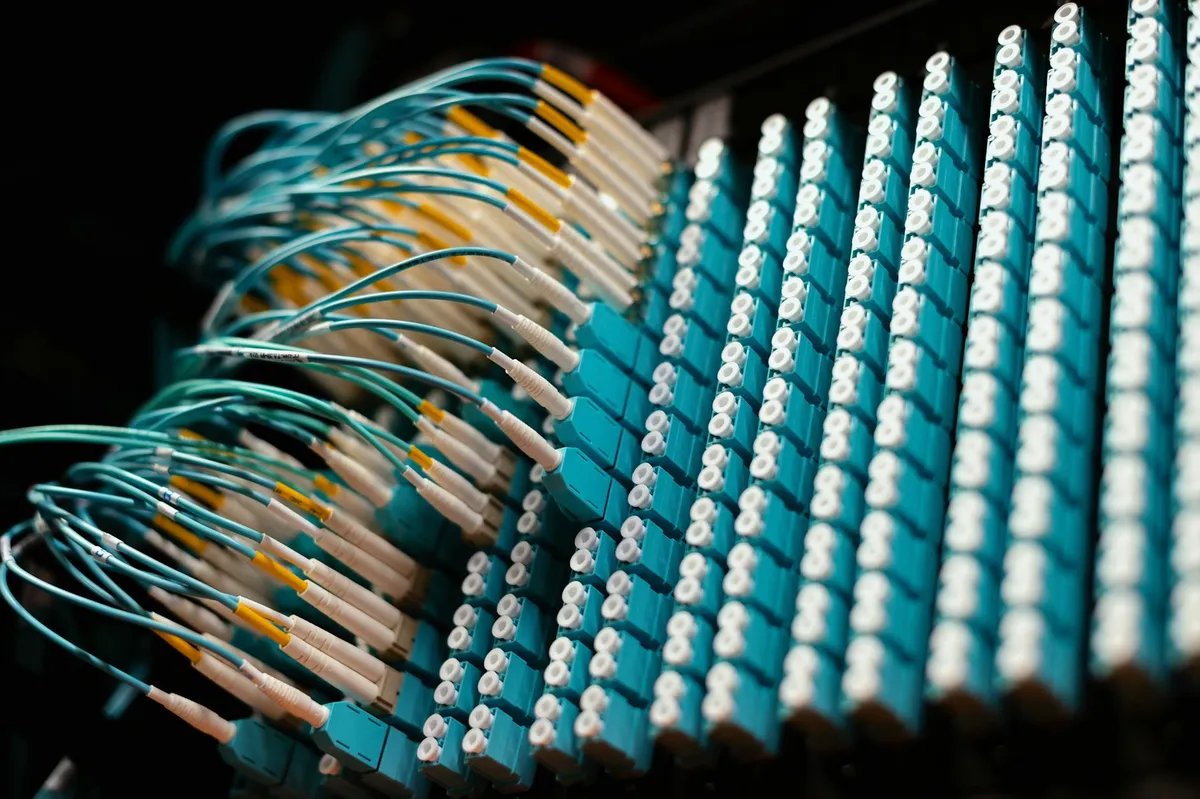
There is a useful corrective for anyone who writes or thinks about mobile networks: at every cell tower in the country, the wireless signal terminates at a steel cabinet, gets converted to light, and is sent down a fiber-optic cable to somewhere else. The wireless part of the journey is almost always the shortest leg.
This is what is called, in the industry, backhaul. The fiber that carries the signal from the tower to the rest of the network. And the build-out of fiber backhaul is, in many ways, the underlying infrastructure story of modern mobile telecommunications. The wireless gets the marketing. The fiber does most of the work.
What backhaul is
A modern cellular site needs to move enormous amounts of data. A single 5G mid-band sector can produce peak throughputs in excess of a gigabit per second. Multiply that across the multiple sectors at a tower, multiply that across the multiple carriers sharing the tower, and a single tower can need to move many gigabits of data continuously.
That data has to get somewhere. Specifically, it has to get back to the mobile core network, which is typically located in a regional data center perhaps fifty or a hundred miles away. The path from tower to core is the backhaul.
For decades, that path was a microwave link — line-of-sight radio between towers. Microwave is cheap and easy to deploy but limited in capacity. The capacity of older microwave links was measured in tens of megabits, then hundreds of megabits. As mobile networks grew, microwave became inadequate.
The replacement, almost everywhere, was fiber.
The fiber build-out
Over the past fifteen years, American carriers have spent enormous sums on running fiber to cell sites. The exact figure is hard to estimate because the spending is scattered across many years and many capital budgets, but credible industry estimates put the total at well over $100 billion.
Most cell sites in dense urban areas now have fiber backhaul. Most cell sites in suburban areas now have fiber backhaul. Even rural sites are increasingly fiber-fed, though some still rely on microwave links to nearby fiber-fed sites that act as aggregation points.
The fiber that feeds cell sites is, in most cases, the same fiber infrastructure that delivers high-speed internet to homes and businesses. The mobile network and the fixed-line network share an underlying fiber layer. The carriers that own substantial fiber infrastructure — Verizon, AT&T, Comcast, Charter, Lumen, and a long tail of regional fiber providers — have a structural advantage in mobile because they own their own backhaul.
Why this matters strategically
T-Mobile, which does not own a comparable fiber footprint, has historically had to lease backhaul from competitors. This is workable but costly. Part of T-Mobile's ongoing strategy is to either build out its own fiber or to develop alternative backhaul approaches — including, eventually, satellite-based backhaul through partnerships with operators like SpaceX.
The convergence of mobile and fixed-line networks is, in many respects, a story about backhaul. The carriers with strong fixed-line businesses can leverage that infrastructure to support their mobile businesses. The pure-play mobile carriers face structural disadvantages in dense areas where backhaul matters most.
The economics of fiber
Running fiber is expensive in absolute terms but cheap on a per-bit basis. The cost of laying fiber is dominated by the construction work — trenching, conduit installation, permitting — rather than the fiber itself. Once the fiber is in place, the capacity that runs through it is essentially free; you can light up additional wavelengths or upgrade the equipment at the endpoints to run faster, without disturbing the fiber itself.
This is why fiber, once installed, tends to last a long time. Fiber installed in the 1990s is still in active commercial use in 2026. The fiber installed today will be used into the 2050s. The cost of installation is amortized over decades.
The economic logic of fiber is, in this sense, similar to the economic logic of cell towers: high upfront capital cost, very long useful life, low marginal operating cost. Both are infrastructure investments that reward patient capital and long time horizons.
The story most coverage misses
Mobile network coverage in the technical press tends to focus on the wireless interface — the air interface between the phone and the tower. This is understandable; the wireless part is where the user experience lives. But the wireless interface is a small part of the network.
The far larger and more expensive part is the fiber and core network behind the tower. The unsung infrastructure investment that has made modern mobile networks possible is the backhaul build-out. Without it, no amount of spectrum or radio sophistication would deliver the speeds and capacities that consumers now expect.
A closing observation
I find myself thinking about this often when I look at coverage maps and speed tests. The wireless coverage map shows where the signal reaches. The actual performance of the network — the speeds, the latencies, the capacities — depends much more on what is behind the towers than on the towers themselves.
The wireless is the interface. The fiber is the network. Most of the work happens in the parts you cannot see.



