
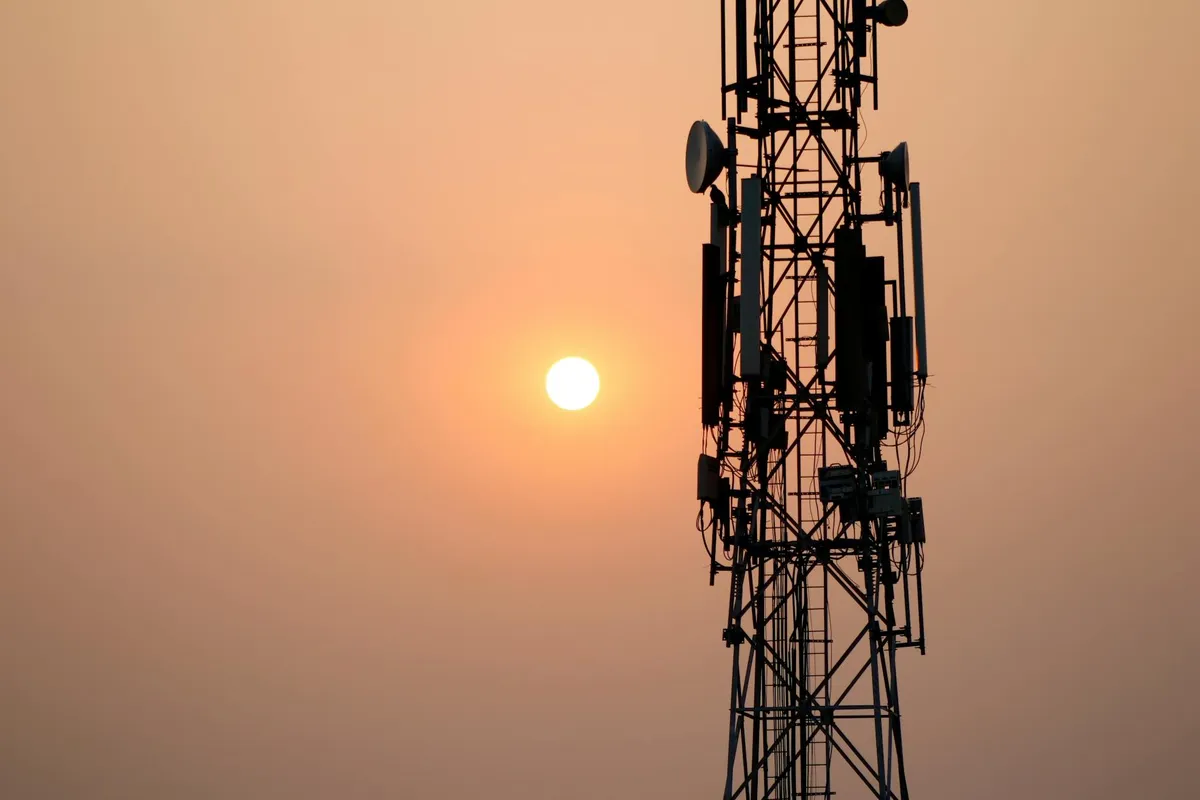
There is a particular cell tower I drive past on the way to my mother's house, just outside the small Pennsylvania town where she lives. It is a lattice tower, painted white where the regulations require it, holding three sets of antennas and what I think is a microwave dish pointed somewhere east. I have been driving past it for fifteen years. It looks exactly the same as the day it went up.
That is, in a sense, the point. Cell towers are designed for forty years. The steel is engineered to hold antennas that have not yet been imagined. The foundations go deep. The land leases run thirty years with options. The carriers come and go, the equipment gets swapped out every five or six years as generations roll forward, but the steel holds.
What towers actually are
It is easy to forget that the entire mobile network — the thing that delivers your text messages and your video calls and the slightly irritating advertisements that follow you around the internet — depends on a national network of approximately 142,000 cellular towers, plus another 350,000 small-cell installations on light poles and building rooftops. Most of them are owned by companies you have never heard of. American Tower Corporation, the largest, owns roughly 43,000 towers. SBA Communications owns 17,000. Crown Castle owns 40,000.
The carriers — Verizon, AT&T, T-Mobile — mostly do not own the towers. They lease space on someone else's tower. The economics of this are remarkable. A single tower might host equipment from three carriers, each paying $2,000 to $4,000 per month per antenna position, plus electrical and maintenance fees. The tower companies make their money by aggregating a few decades of guaranteed lease payments against a one-time construction cost of perhaps $250,000.
The literary problem with towers
Towers are difficult to write about because they are designed to disappear. The white paint is regulatory camouflage. The branding is intentionally absent. The carrier logos that used to be common have largely vanished. A tower is meant to be a thing you do not see.
And yet they are the most physical part of an industry that pretends to be virtual. The cloud is a building in Northern Virginia. The network is a tower outside your town. The metaphors of weightlessness that we use to describe technology are betrayed by the steel.
What changes with each generation
I have been writing about telecom long enough to remember when 3G was the new thing. The towers from that era are mostly still standing. The antennas have changed three times. The microwave links have largely been replaced by fiber. The cabinets at the base of the tower have grown denser and warmer. The towers themselves have not moved.
5G is the first generation that has substantially changed what towers look like. The mid-band frequencies require more antennas, mounted higher and angled differently. The millimeter-wave deployments require many more sites, much closer together, often hung off light poles rather than mounted on traditional macro towers. The small cells multiply across cities like a quiet infrastructure project that nobody discusses.
The tower I drive past
The tower outside my mother's town is fairly typical of its era. It went up in 2008 to support 3G expansion in rural Pennsylvania. It now carries 4G LTE equipment from two carriers and 5G mid-band equipment from one. The steel was engineered to hold roughly twice the load it currently carries.
It will probably hold a sixth-generation network in 2030 or 2032 or whenever 6G becomes commercial. It will probably hold whatever comes after that. The phones will change every two years. The carriers will consolidate or spin off or get acquired. The tower will stand.
There is something almost monastic about this kind of permanence. Most things in the technology industry have a half-life measured in months. The tower has a half-life measured in geological time, by industry standards. Forty years. Long enough that a child born when the tower went up will be a fully formed adult with their own children before the steel needs replacing.
The quieter point
The point of this essay is not really about towers. It is about how the technology industry teaches us to misread time. We are told that everything moves faster every year. We are told that disruption is constant and that nothing lasts. The phones in our pockets are upgraded so often that the version from three years ago feels antique.
And yet the network that carries the signal from those phones runs on infrastructure that long predates the iPhone, on towers that will long outlast it. The fast-moving industry sits on top of a slow-moving one. The visible churn of consumer technology obscures the durable, patient business of laying steel and pulling fiber and waiting forty years for it to depreciate.
I find this comforting. I find it, in some way I cannot quite articulate, beautiful. The steel holds. The signal moves. The years pass.



